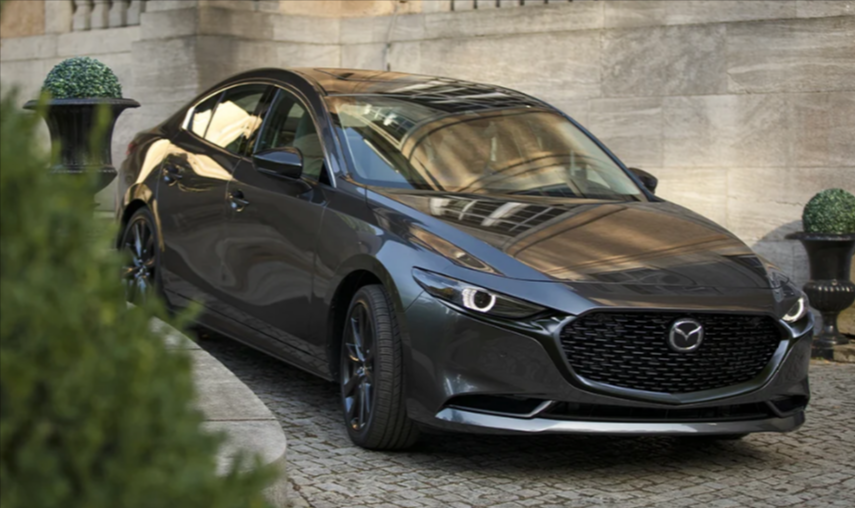
The 2026 Mazda3 continues to occupy a unique position in the compact-car segment. It is available as either a sedan or a Mazda3 Sport hatchback, with a choice of front-wheel drive or all-wheel drive and even an available turbocharged engine.
Some of its characteristics are less widely known, however. Here are five details that distinguish the 2026 Mazda3 and may influence your choice of model.
1. The Sedan and Mazda3 Sport Differ in More Than Their Styling
The Mazda3 sedan and Mazda3 Sport hatchback share their powertrains, platform and much of their equipment. Nevertheless, they satisfy noticeably different needs.
The sedan adopts a more traditional silhouette and provides a separate 374-litre trunk. Folding the rear seatbacks increases available volume to 940 litres, although the opening between the trunk and passenger compartment remains narrower than the hatchback’s cargo opening.
The Mazda3 Sport offers 569 litres behind its rear seats and as much as 1,334 litres when the seatbacks are folded. Its large hatch also makes it easier to load tall or bulky objects.
The Mazda3 Sport is therefore not simply a styling choice. It provides approximately 195 litres of additional cargo capacity behind the rear seats and a more flexible configuration. The sedan remains appealing for its understated appearance and slightly lower starting price.
2. A Manual Transmission Is Still Available
Manual transmissions have nearly disappeared from the compact-car market, but Mazda retains one for 2026. It is offered exclusively with the front-wheel-drive Mazda3 Sport GT.
This six-speed Skyactiv-MT manual transmission is paired with the naturally aspirated 2.5-litre engine. It cannot be combined with all-wheel drive or the turbocharged engine.
All other Mazda3 models use a six-speed automatic transmission with a manual shift mode. Mazda therefore continues to avoid the continuously variable transmissions used by several competitors. The conventional automatic provides more direct gear changes and a more natural relationship between engine speed and acceleration.
The continued availability of a manual transmission is especially rare in a vehicle that can also offer a refined interior, a Bose audio system and numerous driver-assistance technologies.
3. All-Wheel Drive Is Available With Both Body Styles
All-wheel drive is much more common in SUVs than compact cars. The Mazda3 is one of the few vehicles in its segment that combines the lower profile of a car with an available all-wheel-drive system.
It is available on both the sedan and Mazda3 Sport with the GS Luxury Package or GT trim. It is included as standard equipment with the turbocharged engine.
The i-Activ system continuously monitors information such as available traction, acceleration, throttle position and vehicle movement. Mazda says the system uses 27 sensors to analyze conditions up to 200 times per second. It can therefore adjust torque distribution before significant wheelspin occurs.
All-wheel drive cannot replace a good set of winter tires, but it can improve traction when accelerating on snowy or icy surfaces. More importantly, it makes it possible to obtain a winter-ready compact car without necessarily moving to an SUV.
4. The Turbocharged Engine Can Run on Regular Gasoline
The 2.5-litre Skyactiv-G turbocharged engine produces up to 250 hp and 320 lb-ft of torque when using 93-octane premium gasoline.
This power is sent to all four wheels through the six-speed automatic transmission.
What many drivers do not realize is that premium gasoline is not mandatory. With regular 87-octane gasoline, the engine still produces 227 hp and 310 lb-ft. Drivers can therefore choose between maximum performance and the lower price of regular fuel.
The Mazda3 GT Turbo also receives black 18-inch wheels, larger-diameter exhaust outlets, black exterior mirrors and Turbo badging.
Non-turbo models use a 2.5-litre engine producing 186 hp and 186 lb-ft of torque. For 2026, Mazda removed the cylinder-deactivation system from this engine. Power decreases slightly compared with the previous model, but maximum torque remains unchanged.
5. Even the Base Model Is Well Equipped and Covered Without a Mileage Limit
The Mazda3 GX is not a stripped-down car. It includes heated front seats, automatic climate control, LED headlights, 16-inch alloy wheels, push-button start and an 8.8-inch Mazda Connect display as standard equipment.
Its safety technologies include:
- Adaptive cruise control with Stop & Go;
- Smart Brake Support Front;
- Lane Departure Warning;
- Lane-Keep Assist;
- Blind Spot Monitoring;
- Rear Cross Traffic Alert;
- Driver Attention Alert;
- High Beam Control.
Higher trims can add a 10.25-inch display, wireless Apple CarPlay and Android Auto, wireless smartphone charging, a 12-speaker Bose audio system, a head-up display, a 360-degree camera and Cruising and Traffic Support.
The Mazda3 also benefits from Mazda’s unlimited-mileage warranty program. The new-vehicle warranty and roadside assistance are provided for three years, powertrain coverage lasts five years, and the anti-perforation warranty extends for seven years, with no mileage limit on these protections.
The 2026 Mazda3 is therefore much more diverse than it may initially appear. It can be an efficient and well-equipped sedan, a manual-transmission hatchback, an all-wheel-drive compact car or a 250-hp turbocharged model. Few vehicles offer this many personalities within a single lineup.