The Mazda CX-90 is available with two types of electrified powertrains. The first relies primarily on a turbocharged six-cylinder gasoline engine supported by a 48-volt mild-hybrid system. The second is a plug-in hybrid powertrain, also known as a PHEV, capable of completing certain trips using electricity alone.
Both CX-90 models share the same platform, all-wheel-drive system, eight-speed automatic transmission and an interior that can accommodate up to eight occupants. Their operation and advantages, however, are significantly different.
The Gas-Powered CX-90 Is Actually a Mild Hybrid
The CX-90 commonly described as the gas-powered model is officially an MHEV, or mild-hybrid vehicle. Its primary engine is a longitudinally mounted 3.3-litre turbocharged inline-six. A 48-volt electrical system supports the engine to improve low-speed response and recover energy during deceleration.
Unlike the PHEV, the CX-90 MHEV does not plug in and is not designed to travel a significant distance on electricity alone. The driver simply fills the fuel tank as they would with a conventional vehicle. Management of the small electric motor and battery is entirely automatic.
The CX-90 PHEV instead uses a 2.5-litre naturally aspirated four-cylinder engine, an electric motor and a 17.8-kWh battery. It can be connected to a charging station or compatible electrical outlet and driven in electric mode before using its gasoline engine.
Comparison of the Main Specifications
|
Specification |
CX-90 MHEV Inline-Six |
CX-90 PHEV |
|---|---|---|
|
Gasoline engine |
3.3-litre turbocharged inline-six |
2.5-litre four-cylinder |
|
Electrification |
48-volt mild-hybrid system |
Plug-in hybrid system |
|
External charging |
No |
Yes |
|
Power |
280 or up to 340 hp |
Up to 323 hp |
|
Maximum torque |
Up to 369 lb-ft |
Up to 369 lb-ft |
|
Electric range |
Not applicable |
Up to 43 km |
|
Combined fuel consumption |
9.4 or 9.5 L/100 km |
4.2 Le/100 km with charging; 9.2 L/100 km using gasoline |
|
Drivetrain |
i-Activ AWD |
i-Activ AWD |
|
Maximum towing capacity |
Up to 5,000 lb |
Up to 3,500 lb |
|
Maximum seating capacity |
Eight |
Eight |
The Gas-Powered CX-90 Offers Two Power Levels
The CX-90 MHEV GS, GS-L and GT produce 280 hp and 332 lb-ft of torque using regular 87-octane gasoline. Their estimated fuel consumption is 10.1 L/100 km in the city, 8.5 L/100 km on the highway and 9.4 L/100 km combined.
GT-P and Signature models receive a more powerful version of the same turbocharged inline-six. With premium gasoline, it produces up to 340 hp and 369 lb-ft. Output is 319 hp when using regular gasoline. Estimated combined fuel consumption is 9.5 L/100 km.
The inline-six is particularly well suited to drivers seeking smooth power delivery, refined performance and greater capability for long-distance driving or towing.
The PHEV Can Complete Short Trips Without Gasoline
The CX-90 PHEV produces up to 323 hp and 369 lb-ft of torque with premium gasoline. With regular gasoline, total output remains very similar at 319 hp.
Its battery provides up to 43 kilometres of estimated electric range under ideal conditions. That distance may be enough to cover a significant portion of daily driving, particularly when the vehicle is recharged every evening.
When the battery reaches its minimum usable charge, the gasoline engine takes over automatically. Drivers can therefore continue their journey without immediately searching for a charging station. Mazda estimates a total range of up to 801 kilometres with a full battery and fuel tank, although this figure remains a preliminary estimate.
During the winter, the gasoline engine may start even when the battery is charged. It may be required to heat the cabin properly.
Actual electric range will also vary according to temperature, speed, heating use and driving habits.
What Do the PHEV Fuel Consumption Ratings Mean?
The CX-90 PHEV’s 4.2 Le/100 km rating represents the total amount of energy used when the vehicle operates with both electricity and gasoline. “Le” means litre equivalent and converts electrical energy into an equivalent quantity of gasoline for comparison purposes.
This rating assumes that the battery is charged regularly. An owner who rarely plugs in the CX-90 PHEV will not receive its full benefit.
Once the usable electric charge has been depleted, gasoline consumption can reach approximately 9.2 L/100 km combined.
The PHEV is therefore particularly advantageous for someone who has access to charging at home or work and frequently completes trips shorter than 43 kilometres.
Which Model Is Better for Towing?
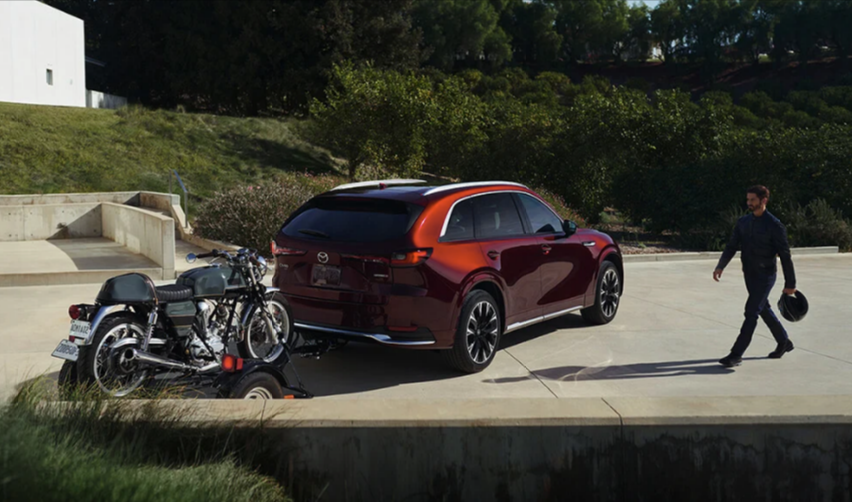
The CX-90 MHEV GS can tow up to 3,500 lb. Properly equipped GS-L, GT, GT-P and Signature models increase that capacity to 5,000 lb with Genuine Mazda towing accessories.
The CX-90 PHEV can tow up to 3,500 lb. Towing mode is available beginning with the GS-L trim.
For a travel trailer or another load approaching 5,000 lb, the inline-six CX-90 is therefore the required choice. The PHEV remains capable enough for a small trailer, certain boats or several types of recreational equipment.
Is the Interior Space Different?
Both models provide three rows of seating. A second-row bench allows the CX-90 to accommodate up to eight people, while captain’s chairs reduce capacity to seven but improve access to the third row.
The availability of these layouts depends on the selected trim. GS models are generally configured for eight occupants, while Signature versions use second-row captain’s chairs.
Despite the installation of its battery, the PHEV retains most of the six-cylinder model’s family versatility. Both models offer the same general level of interior presentation, with displays measuring up to 12.3 inches, an available Bose audio system and premium materials in higher trims.
Which Powertrain Should You Choose?
The CX-90 MHEV is generally better suited to you if you:
- Regularly complete long-distance trips;
- Do not have access to charging;
- Need to tow up to 5,000 lb;
- Prefer the smoothness of an inline-six engine;
- Do not want to change your driving or refuelling habits.
The CX-90 PHEV becomes more appealing if you:
- Can charge regularly at home;
- Frequently complete daily trips shorter than 43 km;
- Want to reduce gasoline consumption;
- Appreciate quiet electric driving;
- Want to combine electric commuting with the flexibility of a gasoline engine.
The best CX-90 is therefore not simply the one with the most power or the lowest consumption rating. The decision depends primarily on the distance travelled each day, access to charging and the required towing capacity.